
Wähle / Choose / Elige – DEUTSCH – ENGLISH – ESPAÑOL – (Category)
Awake – But Not at the Summit
An Honest Look at Spiritual Development
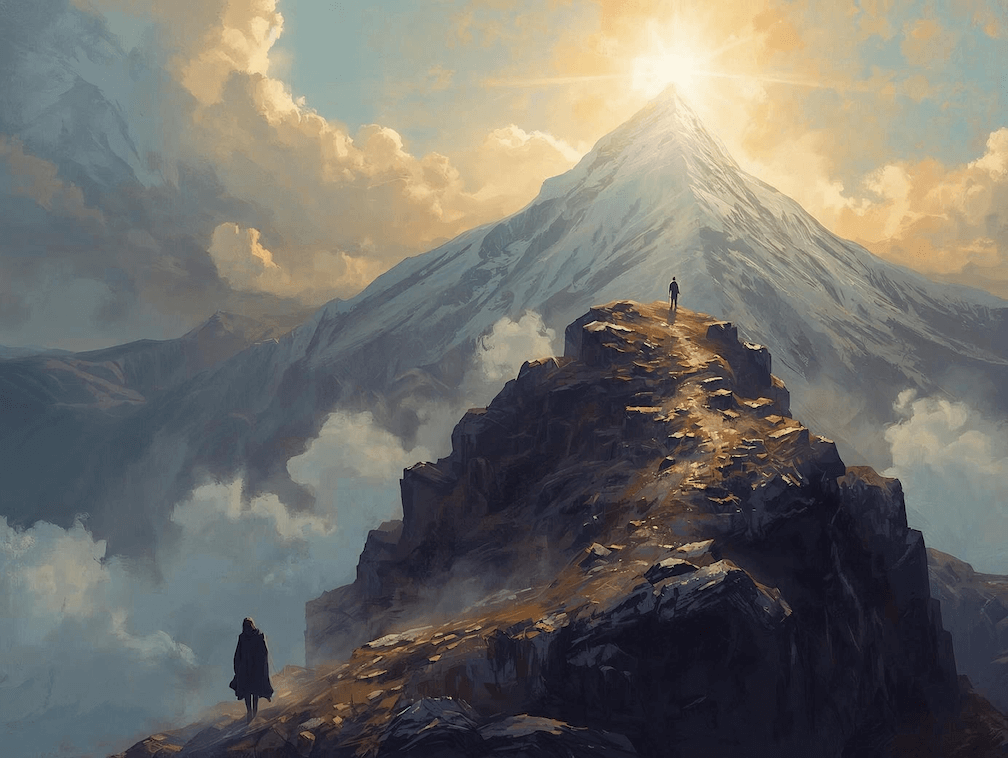
Climbing the Mountain
On my own path it has become increasingly clear to me:
Awakening is not the same as enlightenment.
And yet these two terms are often used as if they meant the same thing. A moment of clarity, an inner awakening – and quickly the impression arises: Now I have arrived
I see the spiritual path more like climbing a mountain.
At some point the fog lifts, the view becomes wider, something recognizes itself – yes. But that does not mean the summit has been reached. It simply means: one is no longer completely at the bottom.
Nothing more.
And from my perspective, this is where one of the greatest traps on the spiritual path begins: confusing intermediate stages with the final destination.
In my experience there are different deepening stages of awakening –
a mental recognition, an awakening of the heart, and an ever deeper embodiment in the body and everyday life. Each of these levels brings genuine insight, real opening and real freedom. Yet none of them automatically means enlightenment.
Why is this important?
Because it makes a difference whether I know where I stand – or whether I believe I am already at the summit.
A false self-assessment does not only limit one’s own development. It becomes especially problematic when one begins to guide others.
This article is an invitation to look honestly at one’s current position,
to distinguish between awakening and enlightenment, and to use the image of the mountain to recognize maturity, responsibility and possible detours on the spiritual path more clearly.
The Image of the Mountain – The Spiritual Path as an Ascent
For me, the image of the mountain describes the spiritual path far more honestly than the idea of a sudden and final awakening.
At the bottom of the valley the search begins – where we are still strongly identified with thoughts, emotions, personal stories and old protective patterns. Where suffering is felt and the longing for truth, peace or freedom arises.
The path upward represents the different processes of awakening. Something begins to loosen, the perspective widens, identifications are seen through.
But this path unfolds in stages.
There are phases of clarity – and others in which we stumble again. Moments of openness and insight – followed by encounters with what has not yet been integrated or fully liberated.
In this image, the summit represents complete enlightenment: a stable, embodied realization of truth beyond falling back into old identifications.
Not only recognized, but lived. Not only understood, but expressed in the body, the nervous system and everyday life – free from being triggered by remaining personal patterns.
The crucial difference, for me, lies between being able to take a deep breath for a moment and truly having arrived.
Someone standing halfway up the mountain may already see very far. The view can be overwhelming. And precisely because of that, the temptation is great to believe one has reached the top.
But a wide view is not the summit.
And clarity about thoughts does not yet equal full embodied freedom of heart, body and action.
This image is not meant to judge but to offer orientation.
It is not about where someone “should” be, but about honestly perceiving where one actually stands.
Only from there can the next step reveal itself. And only from there can we truly accompany others without presenting a viewpoint as if it were the summit – or even leading them astray.
What We Mean by “Awakening”
When people speak about awakening, it is often unclear what exactly they mean.
For some it is a powerful inner experience. For others it is a sudden insight or a state of spaciousness and silence. All of this can be part of it.
At the same time, much confusion arises here:
awakening is easily equated with enlightenment,
although from my perspective they are not the same.
I understand awakening primarily as a first recognition of one’s true nature.
Something essential shifts. One recognizes that one is not the thoughts, not the story, not the role, not the person one believed oneself to be.
This recognition can feel like a breakthrough, like coming home, like a deep inner yes.
Yet this realization often happens first on a mental level. It is a clear seeing – but not yet a full penetration of all levels of being.
Old patterns, protective mechanisms and emotional imprints often continue to operate even when they are seen through.
You know: I am not this.
And yet you still experience: It is still happening.
That is why I see awakening not as an endpoint, but as the beginning of a maturation process.
The perspective widens. But the body, nervous system and relational patterns still need time to adapt to this new truth.
Awakening does not automatically mean freedom from fear, reactivity or old wounds. It mainly means that identification begins to loosen.
What you are becomes clearer – but what you learned to be may still continue to operate.
For this reason it is important not to idealize awakening.
It is not a sign of completion, but of opening.
Not an end, but a transition.
A real step – but not the final one.
Intermediate Stages – Deepening of Awakening
If awakening is understood as a path rather than a single event, it becomes clear that there are different levels and deepenings.
They cannot be sharply separated, yet they reveal different qualities – not to judge them, but to provide orientation.
a) Mental Awakening
A first deepening often appears on the level of understanding.
Thoughts, concepts and identifications are seen through.
It becomes clear: I am not my thoughts, not my story, not my role.
This can be very liberating. Inner contraction loosens, distance arises – one can observe instead of completely losing oneself in experience.
Yet this awakening occurs mainly on the level of recognition. The body and emotional field have not fully caught up yet.
One sees that something is not true – yet still experiences that it continues to operate.
Understanding is not yet full embodiment.
b) Heart Awakening
With further deepening, the heart begins to open.
Compassion, love and connection become more palpable – for others and for oneself.
Old protective mechanisms begin to soften. Emotional patterns are no longer seen only as obstacles but as something that wants to be seen and integrated.
Here real healing often begins. Not because something is removed, but because it is allowed to stand in the light of awareness and love.
Yet here as well: heart opening does not automatically mean complete freedom.
Deep wounds may still have effects, triggers may still appear, and relationship remains a field of learning.
c) Embodiment
Another deepening appears where what has been recognized and felt begins to be lived.
Embodiment means that what has been realized expresses itself in the body, the nervous system, every cell and in everyday life.
Reactions become less compulsive. Presence becomes more stable – also in contact and conflict.
Here maturity reveals itself not in words but in life.
Not in what someone says, but in how they live, how they listen, how they relate to tension, closeness and power.
Embodiment usually unfolds slowly through integration.
d) Subtle Sub-Stages
Between these levels there are many subtle gradations: more stability, more transparency, less compulsion to react, less defense, more humility.
Transparency here means animating the form while simultaneously being the formless – no longer either human or vastness, but both at once.
None of these stages is automatically the summit.
Each brings genuine insight and freedom – but also greater responsibility.
The wider the view becomes, the more essential honesty about one’s actual position becomes.
Why It Is Important to Know Where You Stand
The wider the view opens, the greater the risk of self-deception.
First insights feel vast – and they are. Yet it is easy to mistake a viewpoint for the summit.
One of the most common traps on the spiritual path is the spiritual ego.
Not necessarily arrogance in the classical sense, but a subtle identification with insight.
I have realized something – therefore I am someone.
This can lead to unconscious shadows being overlooked because they no longer fit the self-image.
Reactivity may be played down or spiritually reinterpreted.
Without an honest assessment of one’s position, genuine further development becomes difficult. Growth can only occur where something is still allowed to be seen.
If someone believes they have already reached the goal, they close themselves to further deepening.
This becomes particularly delicate when people begin guiding others.
If someone does not clearly see their own position, they may unintentionally lead others to the place where they themselves are stuck – and present it as the goal.
In this way spiritual dead ends arise.
Knowing honestly where one stands is not a sign of weakness but of maturity.
It protects against self-deception, misuse of power and false authority.
Only someone who knows their own position can truly distinguish between path and destination – and accompany others without presenting a viewpoint as if it were the summit.
Teachers as Mountain Guides – Not as the Summit
In this image I see teachers not as the summit but as mountain guides.
A mountain guide knows the path because they have walked it themselves. They know where it becomes steep, where one can slip and where pauses are needed.
But they can only accompany others to the places they themselves have already reached.
A teacher may have gone very far without having reached the summit. This does not diminish their competence – as long as it is consciously acknowledged.
It becomes problematic only when one’s own position is confused with the destination.
That is why it is essential to know one’s own limitations – not as weakness, but as an expression of integrity.
Someone who knows where they still react personally will project less onto others.
No one can be carried to the summit.
Awakening and its deepenings can be supported, but enlightenment is not a transferable state.
It does not arise through theoretical instruction but through maturation.
A mature teacher does not present themselves as the goal but as a fellow traveler with experience.
Not: “This is how it is.”
But: “This is as far as I have walked.”
Teaching then becomes not an exercise of self-promotion but an act of responsibility – beginning with honesty about one’s own position.
The Summit – Enlightenment as Complete Realization
By the summit I do not mean a special experience or a beautiful state.
I mean a stable and complete realization of truth, free from falling back into personal identification.
Not only recognition – but being.
Not only insight – but complete embodiment.
In my own life in all these years I have encountered only one person in whom I experience this realization: my teacher Amma.
For me there is a freedom there in which nothing personal needs to be defended, no triggering takes hold, and the Divine One Consciousness expresses itself completely through the human form without losing its unity with everything.
This is my personal experience for over more than 23 years.
I have never witnessed anything arising from personal hurt, defense or unresolved history.
For me it is a continuously embodied realization – quiet, human, and yet beyond the person.
But this is not meant as a dogma.
Everyone must feel and discern for themselves.
As always, your deepest heart-truth is your best compass:
The summit is not a place where many stand.
For me it means that in the final step no one actually arrives there.
No person remains who could say, or even feel the need to say: “I made it. I am enlightened.”
There is only realized, embodied being.
For me the summit is the completion of human existence – rare, quiet and not spectacular.
And perhaps its greatest value lies in offering orientation: so that intermediate stages are not mistaken for the goal, and humility, truthfulness and maturity remain present.
The Danger of Misjudgment
When intermediate stages are declared the goal, stagnation arises.
For one’s own development – and for others.
What has not yet been liberated or integrated may then be spiritually reinterpreted.
Personal reactions are played down.
For students this can be confusing and even harmful. They orient themselves toward someone who is still on the path but claims to have arrived.
Thus the viewpoint of one person becomes the detour of another.
Dependence, stagnation or the feeling of being wrong with one’s own unresolved themes may arise.
What actually wants to be seen and integrated is then suppressed or spiritually reframed.
Humility, truthfulness and integrity therefore become protective forces.
They protect us from overestimating ourselves – and from drawing others into illusions.
The greatest danger is not not having arrived.
It is believing that one already has.
How Maturity Reveals Itself
True maturity is not revealed in words or concepts, but in being and in action.
In the way someone meets conflict
Are challenges approached openly and transparently, or does someone still react personally and then spiritualize their behavior afterward?
In relationships
How attentive and present is someone in encounters – without judging or manipulating?
In the handling of power
Is influence used to control, or to support?
In embodiment
Are the proclaimed insights truly visible in the body, the nervous system and everyday life?
What happens when the “territory of the person” is attacked from outside – does someone still need to defend themselves, or is truth simply held in clarity?
Perfection is not the decisive factor.
Honesty and responsibility are.
Maturity is quiet.
It is not proclaimed – it is felt.
Conclusion
The path is not really an ascent but a remembering.
Awakening is not a final goal after which one is “finished”.
And maturity is not a state one possesses.
We can remain attentive to whether our wish to awaken is perhaps an attempt to finally arrive somewhere – while avoiding what wants to be felt, seen and integrated here and now.
The mountain we believe we must climb is often an inner construction born from longing, fear and the idea that we must become someone else in order to be whole.
Yet what we are searching for is not far away.
It lies in the willingness to look.
In the courage not to avoid.
And in the consent to include even the unfinished in Truth.
A mature path is not a path away from being human –
but deeper into it, while resting at the same time in and as the vastness that we are.
When the desire to awaken is no longer an escape,
we arrive – in the body, in life, in being.
The summit and the entire path dissolve.
And yet every step of that path was absolutely essential in order to arrive here.
Invitation
If these words have touched you, perhaps it is because they resonate with something within you.
You do not have to know where you stand.
And you do not have to decide what comes next.
Sometimes it is healing to simply look together –
without a goal, without pressure.
If you like, you can sign up for my newsletter here:
https://www.beingsatsang.com/newsletter/
Or you are warmly welcome to book a free introductory conversation with me, so that together we can sense where you currently stand and whether it feels right to walk a part of the path together.
https://www.beingsatsang.com/kontakt/
If you feel called, you are very welcome.